RC hobby is exciting, but at times may seem complicated and slightly overwhelming.
Mainly for beginners, though, who are in a rush to combine all the bits and pieces into a working setup.
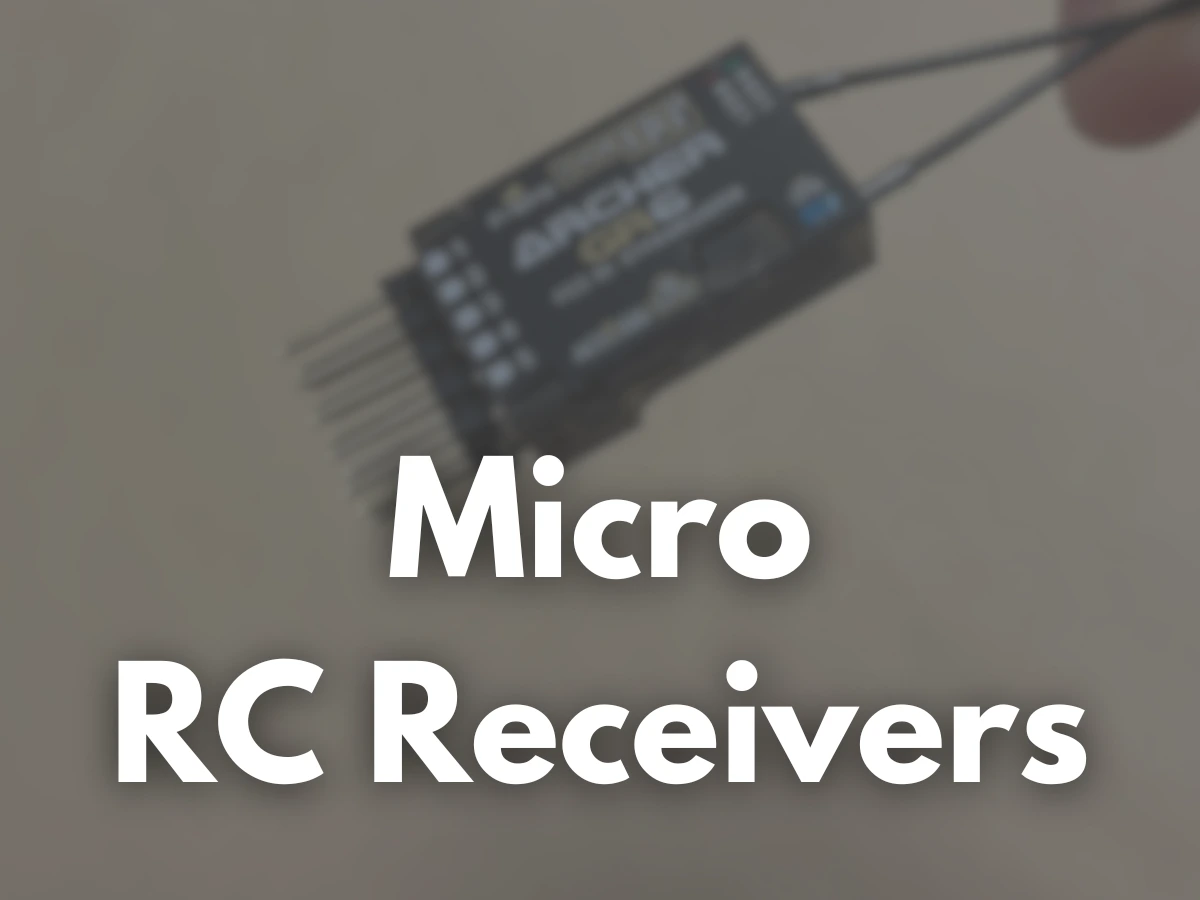
Below, you will learn about micro RC receivers for RC gliders and the radios they work with.
But before that, let’s break down the types of RC receivers you can find.
Let’s dive in.
Micro RC Receiver Types
There are two big categories:
- PWM receivers allow you to plug servos directly in and power them simultaneously.
- Serial receivers (UART/SBUS/etc) are designed to work with flight controllers.
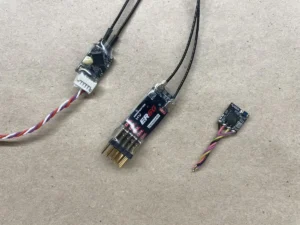
The first type, the PWM, is the one most commonly used for RC Gliders.
Your servos plug directly into it, along with the power from a BEC on the ESC, or from the battery, etc.
The Serial receivers are mostly used on vehicles with flight controllers, where it connects via the serial protocol and do not have a direct connection to servos.
The easiest way to identify the PWM receiver is that it carries a set of contact pins/pads for servos, usually in two or three rows.
These connectors are often universal and compatible with JR/Futaba 3-pin plugs, which are just variations of 3-pin Dupont 2.54mm connectors.
Sometimes, though, the receivers can come with the pins unsoldered.
Telemetry Receivers
Regardless of the receiver type described above, many feature two-way communication, sending data packets back to the transmitter.
This is called telemetry data.
The set of parameters varies based on the radio protocol and settings, but there are some essential ones that are useful for RC Gliders.
- Connection strength via RSSI or Link Quality to know when you are in trouble…
- The Voltage Level supplied either to the Rx board directly or to the dedicated Vx pin if supported.
- Momentary Altitude & Vertical Speed when you are in a thermal or sink.
- GPS Position, Airspeed of your aircraft, etc.
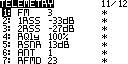
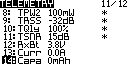
Many modern radios support this feature, and it’s a great way to know what happens up in the air.
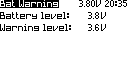
The bare minimum for the telemetry receiver setups is getting the aircraft’s battery voltage reading on your radio.
Knowing that value, you can easily know when to land because of the low battery.
How PWM RC Receivers Differ
Generally speaking, there are two main features that define whether a certain receiver will work for your build.
These are:
- The number of RC channels/plugs physically located on the Rx.
- And the receiver protocol that defines if the Rx will work with your radio.
How Many Channels Do You Need
RC gliders often use micro RC receivers as a power plant for all peripherals.
You connect the battery or a BEC output from the ESC to the Rx, and then feed power to the servos, sensors, and additional electronics.
So, the micro receiver on your model should have space to accommodate all that.
+ 1 extra channel for power input for gliders w/o motors.
Powered gliders with electric motors and ESCs usually supply power to the micro RC receiver from a built-in DC-DC voltage regulator.
This way, the throttle output of the Rx also receives power from the ESC for the entire system.
As soon as you power up the ESC, your whole glider comes alive!
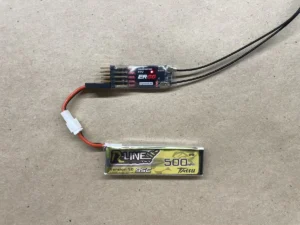
In case of powerless RC gliders, you will need a dedicated plug for power input, like in the image below.
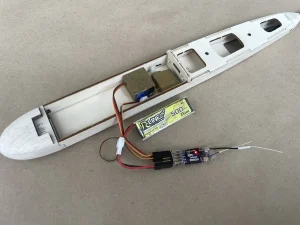
And that’s all for the simple part – the part you can see and touch.
Micro RC Receiver Protocols
Now, it’s time for the invisible – what’s happening over the air between your Rx and Tx (aka Transmitter).
What works with what?
or…
Will some receiver work with your radio?
The answer to that question is most often the radio protocol and the firmware version.
In short, these should match!
But there is such a variety here… so let’s cover at least the most popular.
ExpressLRS, or ELRS
ExpressLRS is one of the most recent open-source protocols, developed primarily by the FPV community.
It features the most stable radio link to date, which is hard to put in a situation to fail.
On the other hand, it requires some complicated settings with a steep learning curve. In addition, the protocol is being actively developed, so fresh updates sometimes add complexity and ofc new features.
For RC glider pilots – do not use anything below version 3.0.x, since it carries some major updates for PWM receivers exclusively.
Second point – turn off Dynamic Power and use static Tx power around 100-250mW. You can do this via the ExpressLRS Lua script on your radio.
Last, use the “full” packet rates for the best performance with PWM receivers, either 100Hz Full or 333Hz Full.
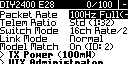
Overall, this is a great protocol if you are into geeky settings and hardware by different manufacturers, with various quality.
And there are multiple brands producing Radios and Receivers running this protocol, so you can choose what you like the most.
DSM, DSM2, DSMS, and DSMX
These protocols are mostly used by Spectrum radios.
However, you can also find Multiprotocol Radios and external modules that will allow you to connect to the matching Rx using this protocol.
This way, you can use, say, a Radiomaster Multiprotocol Radio with a Spectrum DSMX Rx, and more.
FrSky ACCESS, ACCST D8/D16, Twin, Tandem
FrSky has one of the most complicated map of receiver protocols within a single brand, so let’s skim through these.
ACCST D8 is an old one that supports a low number of channels – 8, and can’t provide telemetry to your radio. Can be found in dollar receivers from Aliexpress, but not very reliable these days.
ACCST D16 is a better version of D8, allowing up to 16 channels and telemetry, and a slightly more stable link.
D8 and D16 might work with Multiprotocol Radio Modules by other manufacturers as well.
ACCESS is the next development by FrSky, allowing for up to 24 channels, low latency, telemetry, and multibind support when you connect up to three receivers simultaneously, and many more.
Starting here, FrSky completely closed the development of its radio system and made ACCESS a closed system, unique to the brand.
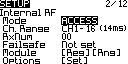
ACCST D16 and ACCESS became quite tricky after FrSky released different versions of these. Generally, there are V1.x.x and V2.x.x versions of the firmware for both, which are not cross-compatible.
Twin and Tandem are the most recent developments for the latest radios, alongside ACCESS, and work with radios that support these protocols.
All of the above are working ONLY when both the protocol and the firmware version match, with minor exceptions.
Futaba FASSTest, FASST, T-FHSS, and S-FHSS
By the name, it’s easy to suggest that these protocols are very specific to Futaba.
And that would be 99% true.
Some exceptions might apply for the earlier versions, where certain micro receivers by third-party manufacturers will work with Futaba radios via these protocols, but lately, that’s a closed system specific to this manufacturer.
JR DMSS, Radiolink FHSS, Flysky AFHDS 2A, FHDS3, Graupner HoTT, Jeti Duplex…
And the list goes on…
Back in the days, every radio manufacturer developed its own communication protocols.
Now, one can often connect to these receivers via a Multiprotocol radio or external modules.
But if you are a happy user of one of these radios, make sure to select the matching Rx.
The Bottom Line
In terms of reliability, some like FrSky D8/D16, Spectrum DSM, DSM2/DSMX, Flysky AFHDS, and similar are now considered proprietary.
Their best range is close to 3km in ideal conditions, which might cause trouble at low altitude at a much shorter distance.
In addition, these radio links often offer limited resistance to interference from public WiFi networks, cellular signals, etc.
And the best part – you can bind to these receivers with a Multiprotocol radios, so the matching brand transmitter is no longer a must.
ELRS, on the other hand, is a very fast-moving, community-driven RC protocol with massive potential and a range of up to … hundreds of kilometers.
See the Long Range Leaderboard – it’s impressive.
For RC glider pilots, it means that you can worry less about interference and failsaves on the flying field and focus on finding lift instead.
Since ELRS can handle almost everything for the line-of-sight flying, even at low transmit power.
However, it has its downsides as well, which adds complexity to the new pilot’s learning curve.
So, what would be your choice?
Leave that in the comments below!